Saturday, January 28, 2023
Seaboard Air Line and Seaboard Coast Line Phase II RS-3s
Monday, January 9, 2023
Prototype Rails 2023
As I collected my thoughts Sunday, I sadly learned Mike Brock, one of the founders of the meet, passed away. I knew Mike well enough through presenting at previous meets, to know he was a gentlemen, a man of many hats, genuine, and his desire to promote the RPM movement was at the forefront of his effort. This year's meet was significant for me as it emboldened friendships and made for the realization that these finite days we are given on the big round rock need to be utilized for the best. Time spent recreating these models is not as enjoyable without the fellowship of friends.
Tuesday, January 3, 2023
SFRP 2106 RR-56 Progress Report
Progress is being made towards completion of SFRP 2106, but it has not been without some difficulties. The lack of Scalecoat II Reefer Orange really had me digging deep for possible paints to use. I unearthed several old bottles of Floquil Military colors such as Orange and Bright Orange, Modelflex SP Daylight Orange, and finally I decided to go with Tamiya Acrylic gloss colors. While not a Santa Fe modeler, I experimented with several shades that looked appropriate for the mechanicals and decided to custom mix my own using their gloss line of colors. I prefer to use Scalecoat II paint as it is easily decaled and is one of the easiest to use paints on the market, but having used Tamiya Acrylics in the past with success, I chose this route for the sake of not having to apply additional clear coats which is where I tend to see the most difficulties with inclusions and humidity.
In 1963, Santa Fe modified their paint scheme to a darker shade of orange. Using the prototype image I had on hand, and knowing that my final color will become muted once a final coat of Scalecoat II flat glaze is applied, I drifted the color to capture a darker hue. The mixing ratio was 15:1:1 of Tamiya X-8 (Lemon Yellow), Tamiya X-6 (Orange), Tamiya X-7 (Red). The color looks really good for Illinois Central and ICG Orange as well.
The ratio was mixed in a 2:1 paint to thinner (Tamiya Lacquer Thinner was used in place of Tamiya Acrylic Thinner) ratio and applied at approximately 1" to 2" from the surface. The model was primed using Tamiya Fine Surface Primer prior to airbrushing the paint mixture at 13 PSI. There are still areas which need to be touched up due to detail obstructions overlaying the model, but these are largely hidden and will be addressed.
One note of interest was I initially used my Paasche Talon with a .68 tip, and found that while excellent for detail painting, it struggled at the lower PSI to give me a good base coat. This resulted in some tiger striping along the panel lines, so I brought in my old reliable Paasche H and eliminated the issue with a broader spray pattern.
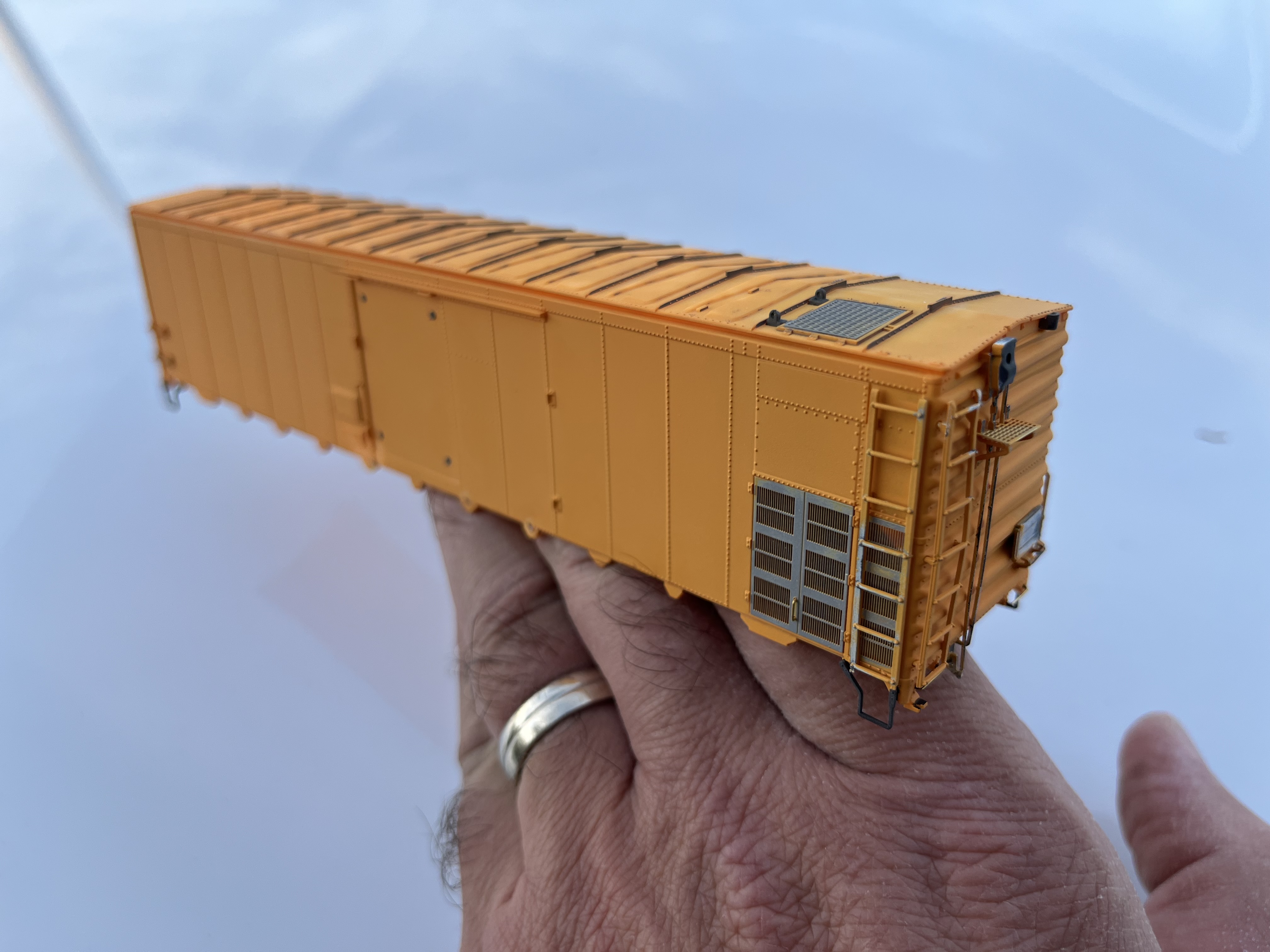
Here are some overall images of the model as it sits awaiting one last round with my airbrush. There is still masking to be done as well to include the sill edges which will be painted black, and the roof will receive a coat of Model Master steel to more accurately reflected the sun beaten prototype's appearance.
While airbrushing, I also removed the door rods and tracks and gave those a good coat which were unaffected by the thinner spray pattern of the Talon.
The door rods will need some additional detail painting to follow the prototype's appearance as they were painted to match the door on the prototype image I am using. The doors were far easier to address, which included sanding them thinner to remove the extra thickness, and a good primer coat. Once dry, I airbrushed the doors using Scalecoat II Santa Fe blue and allowed those to fully cure.
I was anticipating the Tamiya paint to leave a glossy finish such as that found on the doors, but it is inherently different paint than Scalecoat II which I have been using since the demise of Floquil. If I choose to go with another paint, it will be a mix of Scalecoat II Reefer Orange if I can locate a bottle, but with the upheaval at MinuteMan Scale Models, there is not much selection or choice other than hunting down old stock.
Lastly, the underframe components have not been modified as I am awaiting a copy John Moore's Mechanical Refrigerator Cars of the Santa Fe to arrive for closer inspection of the details.
The model has received an improved Kadee Champion brake wheel as one of the detail upgrades, and I plan to use Moloco 70 ton ASF roller bearing trucks until the release of the better trucks under development by Plate C Model Prototypes. The decals will be a mixture of those found on Microscale's 87-255 and 87-510. Overall, the Rapido model has excellent attributes, but could stand some finer details such as the brake wheel and trucks.
Friday, December 30, 2022
Rapido RR-56: SFRP 2106
I began re-construction of Rapido's new Santa Fe RR-56 which will be repainted with some detail upgrades. The model was grit blasted using baking soda in my Paasche Air Eraser, an indispensable tool for modeling these days. I really appreciate the excellent body work of this model along with the etched grilles, however, there are some details which could be improved upon.
The model's color is one of those moving targets, and since converting to Tamiya paint, I will need to experiment with varying ratios and shades to get it close. The model will first receive a coat of primer and then the orange concoction will be airbrushed onto the model. Comparing Santa Fe orange to the various colors at my disposal, I also located two bottles of Floquil Military colors which could be useful for this project as well.
The immediate upgrades will be the replacement of the Champion-Peacock brake wheel with a Kadee equivalent, as well as placing some Moloco 70-ton ASF roller bearing trucks under it until Plate C releases their new ATSF specific truck. The car will be decaled using Microscale sets 87-255 (Santa Fe Mechanical Reefers) and 87-510 (Santa Fe 50' Mechanical Reefers). The model will be lettered in the Texas Chief paint scheme which will match my selected prototype SFRP 2106.
Tuesday, November 29, 2022
Flatcar Deck upgrade - AMB 329
Wednesday, November 16, 2022
ACL P-13 and P-14 flat cars
In reviewing all of the information, ACL began the conversion program of the P-13 series in 1951 with the application of angled bulkheads and 4" steel Zee stringers which replaced the 4" x 3 1/8" wood stringers when constructed in 1942. The bulkheads were modified in 1953, and a second series of cars were modified in 1956. In 1957, the angled bulkhead cars were revised using 3" steel Zee stringers above the trucks. In late 1957, the application of straight steel bulkheads was applied through car 77005. In December 1959, eight P-13 series flats were converted to TOFC service. In 1960-61, ACL constructed additional P-13 straight bulkhead conversion flat cars with upgraded stringers and removable side stakes. In 1961, ACL modified a single log/lumber service P-13 flat car with removable side stakes to assist in loading, however, this car was not equipped with bulkheads. The conversion process continued with the modification of four additional cars with moveable floor risers and 'Jumbo' end cover plates for use in dedicated wallboard/gypsum service.
In all, 85 P-13 series flat cars were modified during 1951-1961 for varying services to include gypsum/wallboard, log/lumber, brick, and TOFC. Thirty-eight of the P-13 series cars equipped with straight bulkheads were equipped with 2 lading compartments on the A end of the car. 12 examples included a single lading compartment, while 7 examples had none. All angled bulkhead P-13 series flat cars were not equipped with lading compartments.
Straight bulkhead conversion lading compartments:
38 cars - 2 lading compartments
12 cars - 1 lading compartment
07 cars - 0 lading compartments
Car number: Year converted: Bulkhead type:
77020 1951 Angled
77037 1951 Angled
77079 1951 Angled
77104 1951 Angled
77122 1951 Angled
77136 1951 Angled
77153 1951 Angled
77154 1951 Angled
77066 1956 Angled
77128 1956 Angled
77156 1956 Angled
77002 1957 Angled
77015 1957 Angled
77022 1957 Angled
77116 1957 Angled
77125 1957 Angled
77000 1957 Straight
77068 1957 Straight
77074 1957 Straight
77110 1957 Straight
77124 1957 Straight
77140 1957 Straight
77150 1957 Straight
77169 1957 Straight
77101 1957 Straight
77168 1957 Straight
77013 1958 Straight
77096 1958 Straight
77003 1958 Straight
77007 1958 Straight
77080 1958 Straight
77098 1958 Straight
77129 1958 Straight
77003 1958 Straight
77007 1958 Straight
77080 1958 Straight
77098 1958 Straight
77129 1958 Straight
77011 1958 Straight
77106 1958 Straight
77107 1958 Straight
77026 1959 Straight
77031 1959 Straight
77045 1959 Straight
77048 1959 Straight
77061 1959 Straight
77086 1959 Straight
77099 1959 Straight
77100 1959 Straight
77102 1959 Straight
77120 1959 Straight
77123 1959 Straight
77126 1959 Straight
77130 1959 Straight
77135 1959 Straight
77139 1959 Straight
77146 1959 Straight
77164 1959 Straight
77166 1959 Straight
77171 1959 Straight
77041 1959 Straight
77137 1959 Straight
77005 1959 Straight
77030 1959 TOFC
77057 1959 TOFC
77065 1959 TOFC
77069 1959 TOFC
77071 1959 TOFC
77083 1959 TOFC
77097 1959 TOFC
77108 1959 TOFC
77056 1960-61 Straight
77004 1960-61 Straight
77014 1960-61 Straight
77021 1960-61 Straight
77146 1960-61 Straight
77161 1960-61 Straight
77032 1960-61 Straight
77084 1960-61 Straight
77087 1960-61 Straight
77142 1961 None
77012 1961 Straight
77117 1961 Straight
77157 1961 Straight
77158 1961 Straight
Straight bulkheads conversion in 1959, File 21.98, General Arrangement S-913, End Arrangement S-912 (Diagram dated 08-13-1959). Two lading compartments at "A" end only.
77026
77031
77045
77048
77061
77086
77099
77100
77102
77120
77123
77126
77130
77135
77139
77146
77164
77166
77171
77041
77137
77005
Straight bulkhead conversion in 1958, File 21.98. Assigned to National Gypsum, General Arrangement S-913, End Arrangement S-912 (Diagram dated 7-18-58). Two lading compartments at "A" end only.
77011
77106
77107
Straight bulkhead conversion in 1958, File 21.98, Assigned to Southern Johns-Manville Company, Jarrett, VA. General Arrangement S-796, Floor stringer arrangement Q-525. (4" Zees @ 8.2# and 3" Zees @ 6.7#) (Diagram dated XX-17-1958). No lading compartments.
77013
77096
Angled bulkhead conversion in 1957, File 21.98, Assigned to US Gypsum Company, General Arrangement Q-525, End Arrangement S-616, Originally 4" x 3 1/8" wood stringers, New 3" Zees @ 6.7# above trucks. (Diagram dated 7-22-58)
77002
77015
77022
77116
77125
Straight bulkhead conversion in 1957, File 21.98, Reconverted from 44'6", 46'0" and 44'8" length cars, Assigned to National Gypsum Company, Savannah, GA. 4" x 4" wood or 4" Zees @ 8.2#, General Arrangement S-796. (Diagram dated 09-17-1958). One lading compartment at each end.
First Lot:
77000
77068
77074
77110
77124
77140
77150
77169
Second Lot:
77101
77168
Angled bulkhead conversion in 1958, File 21.98, Assigned to US Gypsum Company, (4" Zees @ 8.2# and 3" Zees @ 6.7#), Floor structure only Q-525, End Arrangement S-616. (Diagram dated XX-17-1958)
77010
77024
77148
77165
77170
Straight bulkhead conversion in 1958, File 21.98. Assigned to US Gypsum Company, (4" Zees @ 8.2# and 3" Zees @ 6.7#), Floor structure Q-525, General Arrangement S-913. Out shopped September 5-11, 1958. No lading compartments. Diagram dated XX-17-1958.
77003
77007
77080
77098
77129
Angled bulkhead conversion in 1956, File 21.98. Assigned to US Gypsum Company, (4" Zees @ 8.2# and 3" Zees @ 6.7#), Floor structure Q-525, End Arrangement S-616. (Diagram dated XX-18-1958)
77066
77128
77156
Angled bulkhead conversion in 5-1951. Bulkheads modified as per drawing S-616 in 1953. Anchors applied in 1956 per drawing P-446. Assigned to US Gypsum Company. Floor structure Q-525, End Arrangement S-616, (4" Zees @ 8.2# and 3" Zees @ 6.7#) (Diagram dated 1958).
77020
77037
77079
77104
77122
77136
77153
77154
Flat car Piggyback service conversions in 12-1959, File 21.82.7.1, No stringer information listed. Diagram dated 02-03-1960.
77030
77057
77065
77069
77071
77083
77097
77108
Flat car log and lumber conversion, Waycross shops, File 21.98.13 and 21.98.13.1, 4" Zees @ 8.2# and 3" Zees @ 6.7#, General Arrangement N-1080, Diagram dated 06-08-1961.
77142
Straight bulkhead conversion in 1961 at Waycross shops, moveable floor risers, "Jumbo" end cover plates, General Arrangement S-913, End Arrangement S-912. Steel 4" Zees @ 8.2#, Two lading compartments at "A" end only. Diagram dated 06-13-1961.
77012
Straight bulkhead conversion in 1961 at Waycross shops, moveable floor risers, "Jumbo" end cover plates, General Arrangement S-913, End Arrangement S-912, Steel 4" Zees @ 8.2#, Two lading compartments at "A" end only. Diagram dated XX-23-1962.
77117
77157
77158
Straight bulkhead conversion in 1960-61 at Waycross shops, removable side stakes, File 21.98.15, General Arrangement S-913, End Arrangement S-912, Steel 4" Zees @ 8.2#, Two lading compartments at "A" end only. Diagram dated 06-20-1961.
77056
77004
77014
77021
77146
77161
77032
77084
77087
The P-13 and P-14 classes can be accurately modeled using the Proto 2000 (now Walthers) series models and will serve as a future project. The series was later renumbered as SCL 677000-677471 and were largely relegated to specialized service or demoted to Maintenance of Way service where they carried various equipment loads or were modified for tracking laying equipment. The following links show the varying modifications to include deck rails and gondola sides.
http://www.rrpicturearchives.net/showPicture.aspx?id=4917211
http://www.rrpicturearchives.net/showPicture.aspx?id=4415241
http://rchase.rrpicturearchives.net/showPicture.aspx?id=4415240
Friday, October 21, 2022
Seaboard Air Line #60 - Boca Grande
Seaboard Air Line sought to replace all heavyweight equipment on the Silver fleet trains as early as 1947-49, however, due to material and car production shortages, it was not until 1955-1956 that Seaboard would finally take delivery of the final lightweight sleeping cars.
Seaboard Air Line ordered three Pullman-Standard Plan 4201 5-2-2 sleepers for use on the Seaboard Air Line Silver series trains. The sleepers were constructed by Pullman-Standard in January 1956 and were classified as 5- Double Bedroom - 2 Compartment - 2 Drawing Room sleeping cars built in Lot 6969. The cars were numbered as SAL 60 (Boca Grande), SAL 61 (Clearwater) and SAL 62 (Ft. Lauderdale).
In 1967, the series was renumbered as Seaboard Coast Line 6520 - 6522 and retained their car names respectively. On May 1st, 1971, the sleepers were transferred to Amtrak and were renumbered as AMT 2310 - 2312 where they reconfigured as 7 bedroom - 2 drawing room sleepers.
I have long wanted to construct this model and finally had the opportunity to order Union Station Products car sides and core kits. The Boca Grande will built without skirting to accurately model a prototype photograph of the car. Since this will be my first endeavor into this kit line, I will document the build from the outset for a planned article.