Sunday, September 24, 2023

SCL 1207 Progress Report

SCL 1207 seen in May 1968 is trailing SCL 1202 in southern Georgia. The split image scheme of Seaboard Coast Line is one of the most attractive schemes which combines the predecessor paint of Seaboard Air Line and an emergent SCL image.
 

I have chosen to model SCL 1207 in the standard freight scheme using the Rapido RS11. The model was disassembled completely to remove and change the necessary details. In the photos above, you can see the results of the grab irons being removed, the cab glass being removed, and the lettering removed. 


Using a soaked portion of paper towel, I overlaid the paper towel atop the lettering and using Walthers Solvaset decal setting solution, I removed the lettering from both sides of the cab, and one side of the long hood without incident. The side seen above, was a completely different experience. The chemical solutions were varied to include Microscale Microset and Champ decal setting solution which removed the "S", leaving behind, "EABOARD" untouched. I decided to manually remove the lettering using a Paasche air eraser which eliminated the lettering, but marred the remaining paint.


I thoroughly cleaned the model and decided to create a mixture which would closely match the existing paint using Tamiya acrylics. The mixture was begun with Tamiya XF-62 Olive Drab, and darkened using Tamiya XF-9, Hull Red. The paint was darkened sufficiently and I then added three drops of Tamiya XF-3 Flat Yellow. The paint was thinned 3:1 using Tamiya Lacquer Thinner and stirred until all colors were blended. The paint was airbrushed onto the model using 25 PSI and allowed to dry for approximately 30 minutes. The paint obliterated the damaged paint and provided a good base which to my surprise matched exceptionally well. 


The above image of the long hood was the side which did not require any touch-up and the long hood, cab, and short hood were oversprayed using a 6:1 mixture of Glosscote to Lacquer Thinner. After multiple light coats, the model is now ready for decals which will be sourced from Microscale SCL Split Image set 87-1238.

Monday, September 18, 2023

Rapido Trains RS11 - Seaboard Air Line to Seaboard Coast Line conversion


Rapido Trains has released the most accurate Alco RS11 to date decorated for Seaboard Air Line Railroad. A recent delivery of a silent version allowed me to fully inspect the details of the model and share my thoughts on how to enhance the model to more accurately capture the look of a well worn SCL RS11.


SCL 1210, April 1968, courtesy G. Elwood's Fallenflags.org

Prototype information:

The Seaboard Air Line units were the first to be delivered to Seaboard Air Line with dynamic braking capabilities. The 10 unit order (Alco order numbers S3325 and S3333) were delivered in June 1960. These were the first Alco 251 prime mover equipped locomotives on the roster and all were assigned initially to West Jacksonville, Florida and were used primarily south and west of Savannah, Georgia. The units operated short hood forward and were constructed with high short hoods.

The RS11s were numbered SAL 100-109 and were used in 4 or 5 unit consists on fast manifest freights and could often be seen in consist with the 1965 built Alco C420s. All of the RS11s were conveyed to Seaboard Coast Line in July 1967, when they were renumbered SCL 1202-1211. In 1976, all of the RS11s were transferred to power short L&N where they were again renumbered as L&N 950-959. Initially, the units wore a, "L" suffix after the road number (i.e. 1204L) until fully repainted. The RS11s were ultimately retired in 1981 after 21 years of service.

The prototype specifications of the RS11 were 1,800 horsepower Alco 251B prime mover, 40" wheel size, 74:18 gear ratio, 65 mph top speed, 61,130 pounds of tractive effort, 1,800 gallon fuel capacity, 26L air brakes, and were dynamic brake equipped. Of the 10 units, two were repainted using Seaboard Air Line Jolly Green Giant paint, SAL 100 and 101. These units would retain their light green paint through the SCL merger and were renumbered SCL 1202 and 1203.

The Rapido model is well executed and prototypically correct for Seaboard Air Line to include the correct car body filter arrangement and dynamic brakes. The model will serve as a basis for a split image SCL unit and includes highly accurate underframe details, horn, separately applied etched metal grills, and wire grab irons. The revision of the exhaust fan housing looks exceptional as does the cab contour. The horn is accurately shaped and in proportion to standards, however should be replaced with a Leslie RS3L.

The model includes sun shades which must be applied separately, and the wind deflectors need to be replaced with finer etched metal components. The separately applied grab irons are parts which I will replace with finer wire, and am further considering replacing the intercooler piping and screen with aftermarket parts available from KV Models. Overall, the model is an amazing basis to model a split image SCL unit.


The necessary changes to convert the model to a split image SCL unit include:
  • Number board changes from black to white
  • Install ShellScale HO104 Alco numerals
  • Removal of existing herald, road number and SEABOARD lettering
  • Application of new SEABOARD COAST LINE road name and road number (Microscale)
  • Application of a split image herald to the short hood end only
  • Replace end grab irons with finer wire .0125" diameter
  • Replace wind deflectors with KV Models part 1006H
  • Remove segments of orange stripes per prototype photos
  • Weather and reduce opacity of yellow and orange stripes within radiator housing
  • Replace horn with Bowser 190-628, Leslie RS3L
  • Install whip antenna atop cab roof


Sunday, August 6, 2023

ACL 70404 - The W-2 series

The Tichy 4042 pulpwood car is an infinitely useful kit to HO scale modelers who model the pulpwood industry. The kit as built represents an ACL W and W-3 series wood rack with 29'3" truck centers, a 40' length over the strikers, and an overall length of 43' 2.5". The evolution of the pulpwood cars can be traced back to the venerable P-11 flatcar and its many sub-groups. 

The P-11, which can be constructed by way of the Tichy 4040 kit, was divided into 6 groups:

P-11-H, ACL 71000-71199

P-11-J, ACL 71500-71599

P-11-E, ACL 73800-74069 / ACL 74100-74399 / ACL 75000-75514

P-11-C, ACL 76000-76992

The P-11 was first constructed in 1916-17 by Smith and Barney Car Company which featured a 29'3" truck center, a 40' length over the strikers, and an overall length of 43' 2.5". In some instances, not all of the cars were converted resulting in a mix of car types for that group, nor were some of the series fully used. ACL rostered many examples of additional pulpwood cars from builders VB&I Company (Virginia Bridge and Iron), ACF, and Barney and Smith Car Company. 

ACL 70000-70199 and C&WC 4100-4199 (renumbered to ACL 70400-70499) were constructed by American Car and Foundry in 1949. The cars were installed in the ACL W-2 series which featured 38’ interior length between the bulkheads. This car is slightly longer than the Tichy W-3 series kit (part number 4042) which was used as a basis to construct the model. This car will become ACL 70404 when complete.

Sunday, June 11, 2023

Seaboard Coast Line lettering


Using accurate decals is a true joy in the hobby, and all the better when there are sets to accurately capture the dimensional data. When decaling the SCL K-19 gondola project, there were no less than 6 sets used to accurately capture the data.

Mircoscale has long been a staple of accurate decals for many railroads, and ACL, SAL, and SCL are largely in that category. Moreover, the Seaboard Coast Line General Freight set (87-006) is useful, although it contains no dimensional data to fully decal a piece of equipment. The additional sets which include SCL Gondolas and Woodchip hoppers also provided some data, however, it contains minimal data yet again. The data sets 87-462 and 87-463 were used in large part due to the sheer volume of data, however, to accurately capture the look of the prototype, many instances of letter by letter application was needed.


This lead to me review my 1972 SCL Freight Car Stenciling Guide and it proved extremely useful to determine which size lettering is to be applied. This lead me down the path of what could be - Accurate and useful data decal sets for Seaboard Coast Line.

Ideally, SCL data set to include dimensional data of use (boxcar, gondola, flatcar, pulpwood cars, open and covered hoppers) in yellow, black, white and red. Additionally, some of the more common stenciling such as, 2" High Friction Composite Shoes, and reweigh locations such as Hamlet, Tampa, Rocky Mount, Waycross, Jacksonville, Atlanta, and Collier would be a plus too. The reweigh dates should also be categorized by month and year (SCL was formed in 1967 and merged again in 1983), so this is a completely encompassing set of dates. These too should printed in yellow, black, white and red. 

The majority of the set would include number prefixes and numerals logically oriented so that triple splicing of decals would not be necessary. Former ACL equipment typically was numbered in 2XX, 4XX, 6XX series, while former SAL equipment was numbered in the 5XX, 7XX, 8XX, and Maintenance of Way was lettered in the 77X and 99X series. The other needed data are the varying sizes of SCL's unique parallelogram and the different sizes of reporting marks. The variations are significant and unique to each type of car type.


If you are a decal designer, please contact me so I can share my resources with you to prepare accurate SCL decal sets. 

Friday, June 9, 2023

Beware of Squirrels: Past Projects and New Projects

Most recently, I decided to clean out several tubs and totes filled with project materials in hopes of sorting through several thousand detail parts, decal sheets, and under construction projects. Most of which I remembered building, but in my typical, "Look, Squirrel!!" brain, I often push it aside to model something a bit more interesting. 

I've learned through the years, the enjoyment of the hobby for me is the teardown and rebuild process. Painting is usually the least of my favorite aspects of the hobby, but decaling is certainly one of my favorite aspects of prototype modeling. 

In hopes of combating the ever growing list of under-construction projects, I decided to document the list so I have a record of sorts to determine the hierarchy of what to model.

SCL SDP35 616:

An Atlas rebuild with Cannon fans, new underframe details, ESU EMD 567D prime mover, speaker and LED installation.

SCL GP30 1320:

A Proto 2000 GP30 project still in the parts collection stage. The model was striped, grit blasted and is ready for detailing. The locomotive will be DCC equipped, and detailed with wire handrails, and SCL era appropriate details.

Seaboard Air Line #2 Depot:

Constructed as the Wimauma, Florida depot, this is a fun diversion from freight and locomotive projects, but I'm finally getting around to obtaining some parts which were never provided by the manufacturer. The current state of construction is stalled at window installation, and adding a stepped landing. The model is fully painted and awaiting these final details before the roof is sealed and added.

Fruit Grower's Express SAL 591181 RBL:

Still waiting on decals and completion. Such a fun kit to build, paint and construct, but shiny objects got in the way. 

SFRP Rr-56 2106:

Almost across the finish line on this one with some final detail painting left to do. The weathering process and addition of appropriate trucks (Plate C Models, are you out there?!?!) is keeping this one just shy of the finished mark. The Rapido sound units must be made of unobtainium as I've not heard (see what I did there) a sound of them. Still a really fun project and the rebuild, repaint, and decaling process was thoroughly enjoyable.

PFE R70-20:

Part of the reefer block, this one has been fully built and is awaiting the application of black ends and is ready for decaling. This car has been one of the reasons I began building a reefer block in the first place, and again a great kit build.

Seaboard Air Line and Seaboard Coast Line 40' PS-1 Boxcars:

I constructed and have begun the weathering process of the SAL PS-1 in the 1964 Billboard Gothic scheme using the Kadee PS-1 model and it is all built completed. Meanwhile, the SCL PS-1 will be a beer service car which I recently located an excellent prototype photo to finally complete the research process. The SCL variation is painted, and in need of a gloss cote so that decaling can commence. Sadly, there is not an overabundance of photographic evidence of these 40' boxcars.

SCL K-19 Gondola:

This is a Tangent Scale Models parts build and is in the process of receiving decals at the moment. The car is fully constructed, painted and receiving a variety of SCL decals. Likely the closest project to completion given my current push.

SCL U36Bs:

A complete rebuild of the Atlas U36B underframe is in order, and the cab numerals have to be removed and reapplied given the "thinness" of the font used. Once upon a time, Atlas hit dingers when it came to SCL locomotives, but their artwork needs some resuscitation.

SCL RS-3 1155:

A complete Stewart and Atlas franken-Alco project. The model will utilize the Stewart hoods, sill, and an Atlas cab. The majority of the details will be sourced from KV Models as they have made construction of these workhorses easier.

SCL Split Image Alco S-2 and S-4 switchers:

Alco switchers have been a staple of my modeling for decades, and I love the looks and sounds of an Alco. The four of these switchers will be in various states of the Seaboard Air Line inspired black and red Alco switcher split image scheme, while others will find their way into the typical black and yellow Bumblebee paint scheme. Thankfully, Atlas retooled the cab windows to accurately model the later Alco S-4 cab appearance, so these should be a fun painting process.

SCL 5259 Pullman Plan 7600 52 seat coach:

What a project. I'm certain this is one of the longest builds of my model making career and I've lost, found, lost, and found again parts for this car. It is in pieces some of which were waiting for the proper shade of suede, deck tan, and silver. A majority of this car is done, but again squirrels found their way onto my work bench.

SCL 35 Split Image NW2:

If you have ever run a Kato locomotive, you well know that they are simply the best performing locomotives in our hobby. The model was converted to DCC after grinding the frame, and then the shell work began. The lowly switchers get sidelined the most, but it currently appears to be in a porcupine like state with all the various holes filled with styrene rod so that KV Model parts can be applied. The NW2 needs the most work of all my locomotive projects, so I truly need to dedicate some attention to this much needed prototype. It is fitted with a TCS Micro decoder and is in need of reassembly and final construction. I've lost count of how many times I found another example to model, and am waffling about the application of roller bearings to the side frames still. Finding an intact SCL NW2 with solid bearings is akin to finding a hen's tooth.

Seaboard Air Line and Seaboard Coast Line P-9 Phosphate Hoppers:

F&C kits abound throughout my collection in various states of construction. I need only 92 more of these to complete my endeavor, but I really need to consider some 3D printed details or etched ladders to make these as good as I want them to be. "Model Phosphate Trains, It will be Fun!" says the guy....

This is a short list of current projects, and in no way accounts for what other treasure I located such as fully re-constructed SW9s, DS4-4-1000s, SDP35s, GP40s, and many more. Beware of the squirrels, and in a year, I hope to have finally put some of these projects into the pages of the Seaboard-Coast Line Modeler


Sunday, April 30, 2023

Tangent ACF 70-ton welded gondola project


I always enjoy a good kit build, and fortunately, Tangent Scale Models still provides an opportunity for modelers to purchase parts. This gondola is one of 100 examples purchased by Atlantic Coast Line in 1952 from American Car and Foundry (ACF) which were originally numbered as ACL 98000-98099. This group was classified as the K-19 series which were used in specialized tin plate service as well as general service.

The model was originally released in 2009, and again in ready to run form in ACL's black carbody with white Prismo striping in 2011. I originally ordered a primed example and rolled my own after several years. The model is an excellent representation of the prototype with only one detail variation required for any cars beyond their initial delivery years.


Some notes from my files on the K-19 series:

  • 70 ton rating
  • 1647 cubic foot capacity
  • fabricated from steel using 26 pressed steel side stakes (entire car, 13 per side)
  • US Gypsum brake step
  • Miner type A-22XL draft gear
  • Lever type handle brakes, Union Asbestos & Rubber Co.
  • ASF A-3 Ride control side frames with 33" one wear wrought steel wheels
  • Stucki roller bearings
  • ACF drop end locks and lading anchors
  • Nailable steel flooring by Great Lakes Steel Corporation

Of note - the original K-19 diagram contains the post spacing as follows - 5' 1 1/8" - 3' 11" - 3' 7" - 3' 7" - 3' 7" - 3' 7" - 3' 7" - 3' 7" - 3' 7" - 3' 7" - 3' 7" - 3' 7" - 3' 11" - 4' 5 7/8". The extreme width is 10' 6 15/16", Interior width  9' 6", end opening 8' 9", overall length coupled 57'2", interior length 52' 6", and truck centers of 43' 8".

The series as a whole were transfered to the 698000-698099 series, with a key group going into dedicated coil tinplate service. The following 15 cars were removed from the series and placed into coil tinplate service: ACL 98002, 98004, 98005, 98028, 98036, 98047, 98048, 98055, 98059, 98066, 98070, 98071, 98077, 98080, and 98092. These 15 cars were initially removed from the general pool and given hoods to protect coils. ACL constructed 30 sets of covers in total for the series with 23 covers constructed by the Rocky Mount, NC shops in 1957, and 7 additional sets constructed in 1959 again at Rocky Mount. 

On May 4, 1965, 7 of the listed cars were removed from the dedicated service and returned to the general pool.  On May 23, 1967, 5 additional cars were removed from the dedicated service and returned to the general pool. Of the original 15 cars, 5 remained in dedicated service as of 1972. 

Structurally speaking, the cars remained the same save for triangular braces added near the top chord which served as guides for insertion of the covers. The removable covers measured 14' 9" by 8' 11" by 5' 10 3/8". The covers are labeled as drawing No. S-845 and are also given special loading instructions under drawing No. S-846. A general arrangement drawing for the series is listed under drawing No. S-588. The coiled tinplate cars were transferred into SCL series 698000-698099 at the 1967 merger and the 15 cars were listed as 698002, 698004, 698005, 698028, 698036, 698047, 698048, 698055, 698059, 698066, 698070, 698071, 698077, 698080, and 698092.

After examining multiple prototype photos, the defect car holder was removed and as such, it is quick work of this cast on part. I located an in-service photograph of these recently which garnered my attention and will become a source for an article. The heavy lifting is nearly complete in this image, with only grab iron installation, brake equipment and final details to be installed. 

Tangent's excellent customer service and ready to run models have no rival in HO scale, and I appreciate their attention to the kit builders out here.

Tuesday, February 21, 2023

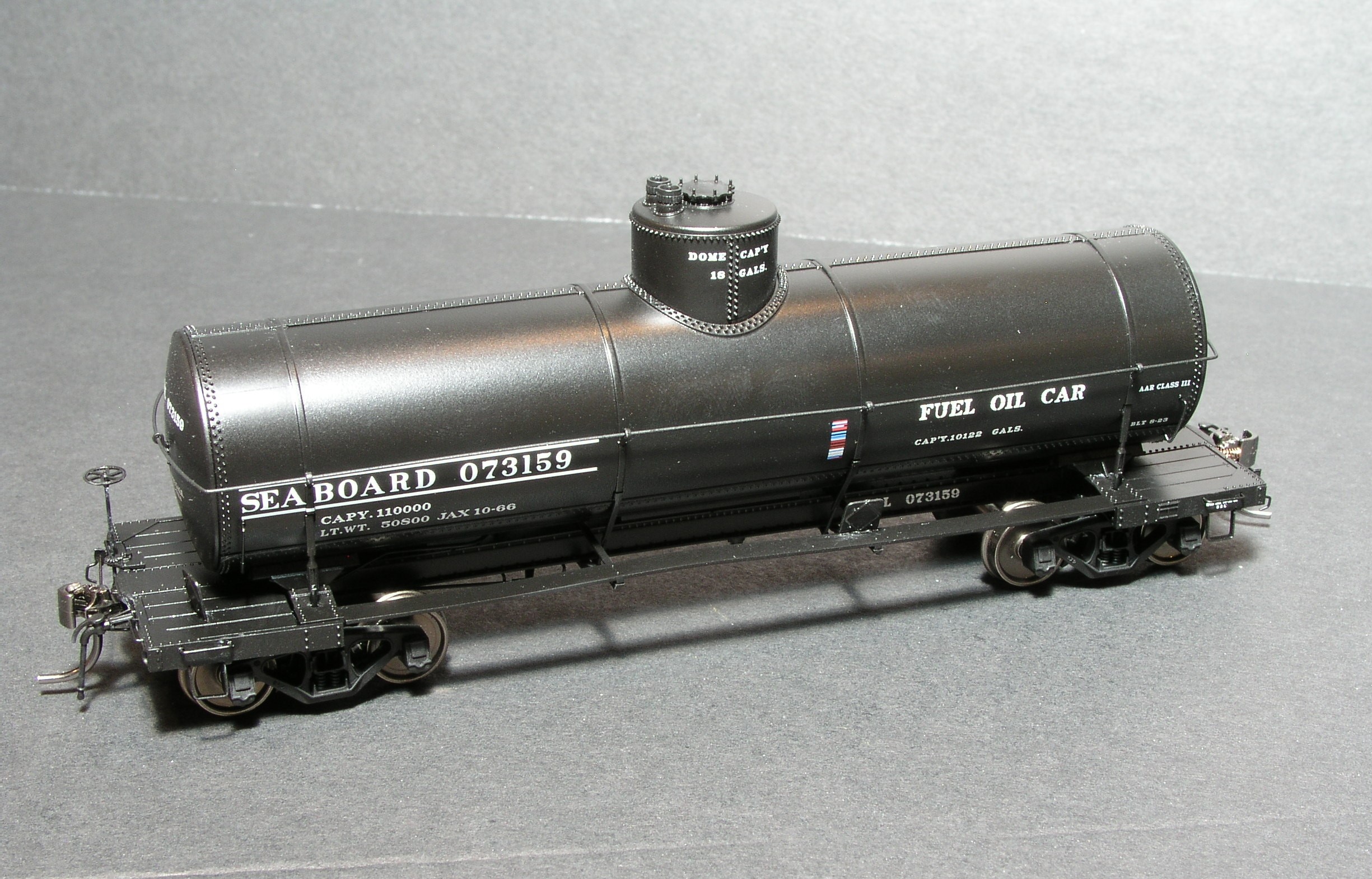
Seaboard Air Line Fuel Oil cars


Rapido Trains recent release of the UTLX X-3 10,000 gallon tank car has allowed me to install three examples of these unique cars on my roster. The use of fuel oil cars lasted well into the 1960s on SAL and later SCL which saw frequent movement between terminals and outlying points where fuel was not immediately or readily available. The three cars are common such that it is possible they could have been interspersed in manifest freights. As more information is found, these excellent models will be more thoroughly documented as I am able to uncover more details. The application of the ACI label is a great addition for my era and these appear to be highly accurate detailed models that will serve as an interesting mix to several other era appropriate tank cars on my roster which saw frequent service at the Belcher Oil loading point on south Boca Grande.